

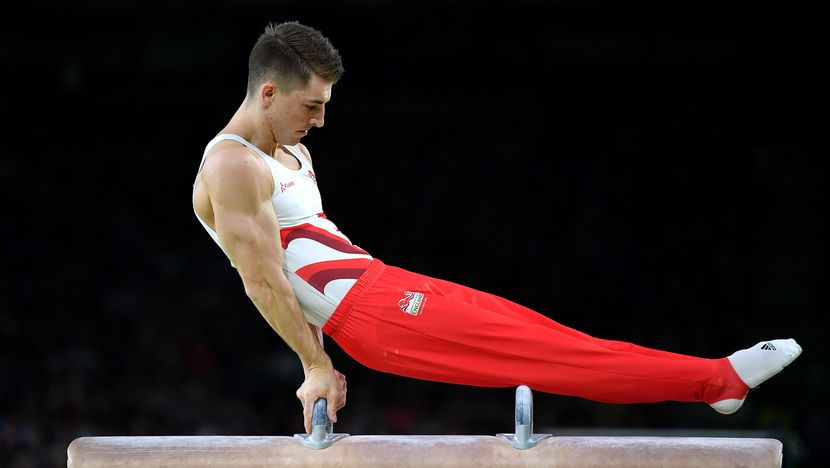
Max Whitlock’s Unfinished Business
He is the most decorated pommel horse gymnast in Olympic history. He has never won a Commonwealth Games title.
Max Whitlock has won almost everything gymnastics has to offer. With three Olympic golds plus World titles and European crowns, his career raised the bar for British gymnastics.
He is the most successful British gymnast in history and the most successful pommel horse gymnast the Olympic Games has ever seen.
But ask him about the Commonwealth Games pommel horse, and the conversation changes.
Three finals. Three silver medals. Each one a near miss with its own particular story.
The first came in Delhi in 2010, when Whitlock was just 17 years old and making his senior Commonwealth debut. He had not arrived as a favourite. This was a first step onto a major stage, not the defence of anything already won.
Australia’s Prashanth Sellathurai provided the measure of the level Whitlock would need to reach. A three-time World Championship medallist on pommel horse, Sellathurai scored 15.500 to take gold. Whitlock finished with 15.125, a gap of 0.375.
It was not a heartbreaking near miss. It was a teenager being beaten by a seasoned world-class competitor.
Whitlock would later describe Delhi as an experience that shaped his career; it was less a disappointment and more of a learning curve.
Glasgow 2014 was another story.
By the time the pommel horse final arrived, Whitlock had already collected gold in the team event, the all-around and the floor, but three golds don't guarantee you a fourth. Scotland’s Daniel Keatings and England teammate Louis Smith were both capable of taking the title.
Keatings went first. Competing in front of a home crowd that had been willing him to the top of the podium all Games, he produced what his coach Paul Hall would later describe as a final that would not have looked out of place at an Olympics. His difficulty score was lower than Whitlock’s, but he nailed every element, posted 16.058, and sat back to watch the pressure build on his rivals.
Louis Smith went next and held it together until the final handstand on dismount, where a slight delay cost him dearly. Then Whitlock, last to go, knowing exactly what the target was, had handstand trouble of his own. He scored 15.966. The margin was 0.092 of a point.
Whitlock had attempted the harder routine, but it did not pay off.
Then came Gold Coast 2018, where Whitlock had been peerless on the pommel for three years and arrived as the overwhelming favourite. His challenger was Rhys McClenaghan, an 18-year-old from Antrim who had watched Whitlock since the Delhi Commonwealth Games in 2010.
The two finished level on 15.100, and when the judges separated them on execution, McClenaghan's 8.600 against Whitlock's 8.300, it was the kid who had idolised him who took the gold. Whitlock took home his third silver.
It is a strange footnote in a career built around the pommel horse. The apparatus that delivered Olympic gold in Rio and Tokyo, and became shorthand for British gymnastics excellence, has never once yielded a Commonwealth title.
When Whitlock stepped away after Paris 2024, most assumed that chapter was closed.
It was not.
His return is driven by a bigger goal: Los Angeles 2028 and the possibility of becoming the first British gymnast to compete at five Olympic Games.
But while the Olympics may be the destination, Glasgow 2026 offers something else. It gives him one more opportunity to win the title that has somehow eluded him for 16 years.
